


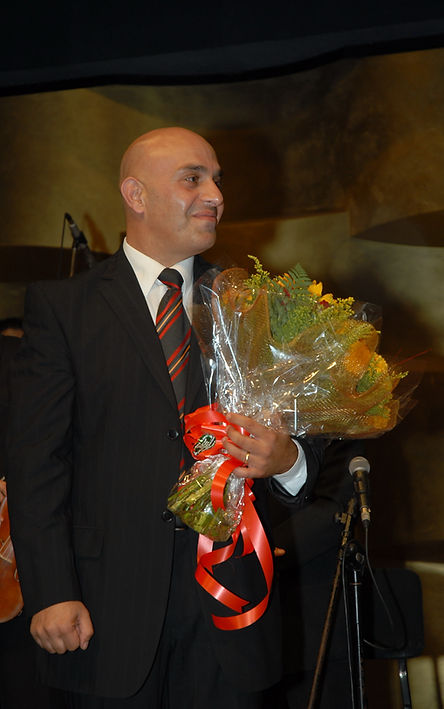


Dr. Taisser Haddad
Dr. Taisser Haddad, a distinguished Palestinian composer, conductor, and academic, was born on May 9, 1967, in the village of Tarshiha in the Upper Galilee, into an artistic family. His passion for music began at an early age, playing the piano and keyboard alongside his father, educator and musician Nasrat Jiries Haddad. He pursued higher education in music and obtained a Ph.D. from the Hebrew University of Jerusalem, becoming an influential music researcher, participating in scientific conferences, and teaching music at universities and higher institutes.
Musical and Artistic Contributions
Haddad dedicated his career to promoting Arabic music, integrating traditional Eastern instruments into global orchestral arrangements while preserving the Palestinian musical identity and contributing to its evolution.
He participated in numerous international festivals, including:
-
Ramallah International Festival
-
Arab Music Festival – Cairo Opera House
-
Jerash Festival – Jordan
-
Fes Festival – Morocco
-
Jerusalem as the Arab Capital of Culture – An-Najah University
-
International Oud Festival – Jerusalem
-
Festivals in London, Greece, and the United States
He also led prominent musical ensembles, such as:
-
Tarshiha Arabic Music Ensemble
-
Ensemble Kayan
-
Middle Eastern Ensemble at the University of Haifa
-
"Cathrina" Municipal Conservatory Orchestra in Tarshiha
Musical Compositions
Haddad composed and produced several musical albums, including:
-
Martyr of Golgotha
-
Palestinian Women’s Songs
He also composed songs and musical pieces, such as:
-
My Last Love (1998)
-
Tell Me About Myself (2003)
-
You Are Beautiful (2004)
-
Is This Love? (2012)
-
Shadi (2013)
-
Your State is Like Mine (2014)
-
I Won't Speak (2014)
-
Operetta: We Love Life (2014)
-
Beirut, the Apple (2020)
-
One Day, I Will Be What I Want (2016)
In instrumental music, he composed:
-
Dozan (2001)
-
Shatharat (2002)
-
Baladiyat (2009)
-
Capriccio (2011)
-
Saltana (2017)
-
Inspired by Tango (2020)
Haddad also gained recognition for his musical arrangements of works by Farid Al-Atrash, Mohamed Abdel Wahab, Umm Kulthum, Fairuz, and Abdel Halim Hafez. Additionally, he produced numerous televised musical performances, including:
-
The Sad Musician – Farid Al-Atrash
-
The Musician of Generations – Mohamed Abdel Wahab
-
The Three Greats – Umm Kulthum, Asmahan, and Leila Murad
-
Music of Bilad Al-Sham – Sabah Fakhri
-
Contemporary Lebanese Art – The Rahbani Family, Fairuz, and Wadih Al-Safi
-
The Nightingale – Abdel Halim Hafez
-
Middle Eastern Jazz – Ziad Rahbani, Sayed Darwish, Sheikh Imam, and Taisser Haddad
Academic and Educational Contributions
Haddad is a prominent figure in music education, holding key academic positions, including:
-
Head of the Music Department at the Arab Academic College of Education in Haifa
-
General Inspector of Music Education and Arts at the Ministry of Education
-
Lecturer at universities and higher institutes, such as:
-
The Academy of Music and Arts in Jerusalem
-
University of Haifa
-
The Academic College of Arts in Safed
-
Sakhnin College for Teacher Training
-
He has also published numerous scientific studies and educational materials in the field of music education, contributing to the cultural and musical awareness of younger generations.
Founder of "Cathrina" Municipal Conservatory
In 1994, Dr. Taysir Haddad founded the "Katrin" Conservatory in Tarshiha, which became a vital cultural center for teaching both Eastern and Western music. The conservatory nurtures new generations of musicians through specialized academic programs covering all musical instruments and theoretical studies.
His Global Musical Legacy
Despite political challenges, Haddad succeeded in delivering a comprehensive musical experience, bringing the Palestinian voice to international stages. He left a unique mark on contemporary Arabic music, serving as a bridge between heritage and innovation.